Quark vs Skyr
Quark and skyr share cultured-dairy territory, but their names describe different traditions. Neither name alone tells you the protein, sugar, or texture of every product.
Cultured Compare is an independent comparison resource. We do not manufacture dairy products.
Quark and skyr at a glance
Quark and skyr are distinct cultured dairy traditions, even when both look thick and spoonable. Quark is a fresh, unripened cheese. Skyr is associated with Icelandic cultured dairy and is commonly sold in the US alongside yogurt.
Even manufacturer terminology varies: siggi’s describes its skyr as strained yogurt, while Icelandic Provisions emphasizes skyr as a distinct product made with skyr cultures. We preserve skyr as its own comparison category instead of treating it as another name for quark or Greek yogurt.
Cultures, curds, and straining
Quark production uses cultures to acidify milk, forms a curd, and separates whey; rennet may assist coagulation. The result is a fresh cheese, as described in the Canadian Dairy Commission’s production profile.
Skyr also involves cultured milk and concentration through straining. Its culture tradition and the producer’s formulation matter. Icelandic Provisions describes its Icelandic-origin skyr cultures; siggi’s describes incubating milk with cultures before removing whey.
There is overlap in those broad steps. A simple rule such as “one is strained and the other is not” misses that overlap. The category tells you a tradition, not the complete factory recipe or ingredient list of every product.
Texture and ways to use them
Quark ranges from thick, spoonable products to richer, spreadable styles; skyr is typically dense and spoonable. Our What Is Quark? guide explains that range with manufacturer references. Both can have a cultured tang. How firm, rich, or sour a particular cup feels depends on its recipe, so these descriptions are a starting point rather than a tasting verdict.
For a spoon-and-bowl breakfast, choose the flavor and consistency you like, then compare the label. If you want to spread it on toast, pay attention to how well it holds its shape. For a dip, start with plain and season to taste.
5 Generations Creamery suggests quark with fruit, on toast, and in dips. Those are useful ways to explore its texture before treating it as a baking ingredient. Flavored skyr is a separate formulation to assess, not just plain skyr with an interchangeable nutrition label.
Nutrition depends on the product
The table compares one spreadable Vermont Quark with Icelandic Provisions Traditional Plain Skyr. It normalizes the declared servings to 100 g. Neither result should be generalized to every brand, milkfat level, or flavored version. Vermont Quark is one formulation within a varied category.
Scroll across the table to see all nutrition values.
| Product | Label serving | Protein | Calories (kcal) | Total sugar | Added sugar |
|---|---|---|---|---|---|
| 5 Generations Creamery Vermont Quark — 8 oz | 28 g | 7.1 g | 143 | 3.6 g | Not provided |
| Icelandic Provisions Traditional Plain Skyr — 5.3 oz | 150 g | 11.3 g | 80 | 2 g | 0 g |
Values are calculated from each declared serving and rounded for display. These specific products are examples, not category averages. A dash means not provided, not zero.
- 5 Generations Creamery: nutrition source · Checked
- Icelandic Provisions: nutrition source · Checked
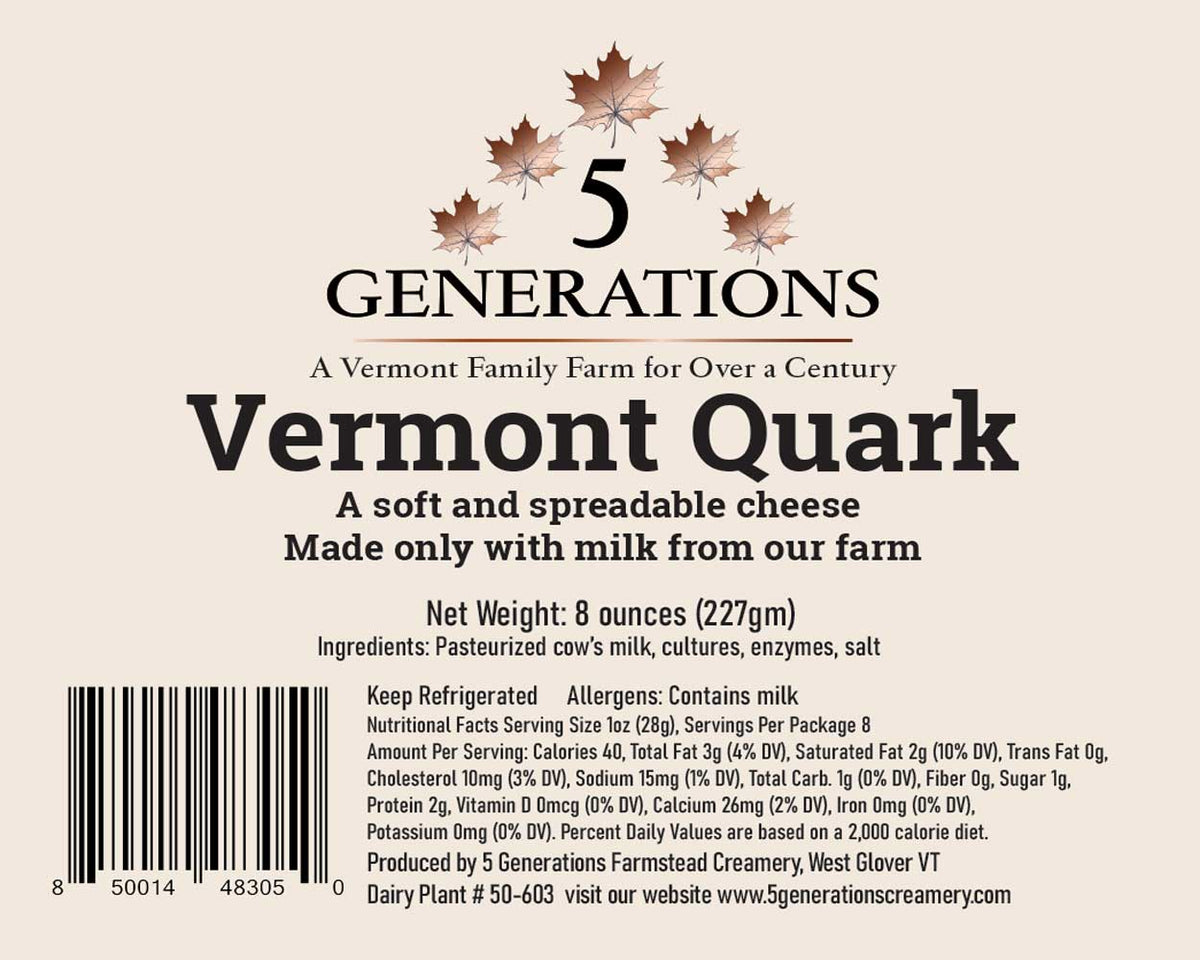
Open the Vermont Quark record and Traditional Plain Skyr record to inspect the source labels and original servings. A larger serving can carry a larger protein number without settling the comparison at equal weight.
The quark label does not separately declare added sugar. Its dash is an unknown, not zero. As the FDA’s sugar-label guide explains, total sugar can include naturally occurring milk sugar even when added sugar is zero.
Swapping quark and skyr in the kitchen
For a cold bowl, spread, or dip, trying one in place of the other is a practical taste-and-texture experiment. Start with comparable plain products and adjust the other ingredients gradually.
For baking or a firm dessert filling, follow a recipe written for the chosen ingredient. Different moisture and consistency can affect the result; we have not tested a universal quark-to-skyr replacement ratio. The nutrition examples above are label comparisons, not a recipe test.
Choosing between actual US products
Use the quark filter and skyr filter to inspect each group, then compare the products together. Check the source date, declared serving, protein, calories, total sugar, and added sugar.
A category name does not establish a lactose-free claim or other dietary attribute. Use explicit information for the actual product. Our collection also does not tell you whether a nearby store has stock; manufacturer links are references, not retailer-availability checks.
If Greek yogurt is also on your list, our quark vs Greek yogurt guide explains that comparison separately.
Sources and review notes
Process descriptions use the references below. Manufacturer sources describe their own products. Nutrition examples use our checked US records or explicitly identified overseas editorial references, with individual source dates, rather than category averages. Overseas references are not US directory listings.
- Canadian Dairy Commission — Quark Cheese
- Arla Sweden — What is kvarg? (Swedish)
- Icelandic Provisions — Skyr FAQs
- siggi’s — US Frequently Asked Questions
- 5 Generations Creamery — Fresh Vermont Quark
- FDA — Added Sugars on the Nutrition Facts Label
Editorial references reviewed Oct 29, 2026. Brand formulations and source pages can change; a source check does not verify current packaging or retailer stock.
Put the labels side by side.
Explore checked US products, filter by category, and compare nutrition on the same basis.
Open the comparison