Quark vs Greek Yogurt
Both can be thick, cultured, and eaten with a spoon. The useful differences start with how they’re made and end with the particular label in your hand.
Cultured Compare is an independent comparison resource. We do not manufacture dairy products.
The short answer
Quark is a fresh cultured cheese; Greek yogurt is a concentrated yogurt. Their smooth textures can overlap, but the production traditions and specific recipes differ. The Canadian Dairy Commission’s quark profile and U.S. Dairy Export Council’s Greek-style yogurt overview describe those different starting points.
Neither name guarantees more protein, fewer calories, or less sugar than the other. A useful comparison needs two actual products, the same weight, and an understanding of any missing label information.
Quark includes thick, spoonable products as well as richer, spreadable styles. Our What Is Quark? guide explains that range with manufacturer references. The Vermont Quark example below represents one spreadable formulation; its nutrition should not be generalized to all quark.
How their production differs
Quark begins with cultured milk forming a fresh curd; enzyme-assisted coagulation may also be used. The German Federal Centre for Nutrition describes how this differs from yogurt fermentation. This is background on production, not a specification for every US brand.
For Greek yogurt, a yogurt base is concentrated, often by separating liquid whey. The U.S. Dairy Export Council also describes membrane filtration and a different approach that adds dairy proteins. In other words, “Greek-style” does not mean every manufacturer follows one identical straining process.
If added milk proteins or other ingredients matter to your choice, read the ingredient list of the specific product. A category label alone cannot settle that question.
Texture, flavor, and everyday uses
Quark is generally smooth and mild with some sourness; Greek yogurt is thick and cultured-tasting. Those descriptions overlap, and they are not a reliable ranking of which product will feel creamier or taste more tart.
For a bowl with fruit, either plain product gives you room to choose the toppings. For toast or a dip, choose the consistency you want: a firmer product may spread well, while a looser one may need less thinning. 5 Generations Creamery’s quark suggestions include both spreads and sweet uses.
Milkfat level, flavoring, and the finished recipe can make as much practical difference as the category. Compare plain with plain first if you want to understand the base products.
Compare nutrition on the same basis
Here are two checked US examples: Vermont Quark and FAGE Total 0% Plain. Their declared serving sizes differ, so the nutrient columns use 100 g for both. These are particular formulations, not a controlled comparison of every quark and Greek yogurt.
Scroll across the table to see all nutrition values.
| Product | Label serving | Protein | Calories (kcal) | Total sugar | Added sugar |
|---|---|---|---|---|---|
| 5 Generations Creamery Vermont Quark — 8 oz | 28 g | 7.1 g | 143 | 3.6 g | Not provided |
| FAGE Total 0% Plain Greek Yogurt — 5.3 oz | 150 g | 10.7 g | 53 | 3.3 g | 0 g |
Values are calculated from each declared serving and rounded for display. These specific products are examples, not category averages. A dash means not provided, not zero.
- 5 Generations Creamery: nutrition source · Checked
- FAGE: nutrition source · Checked
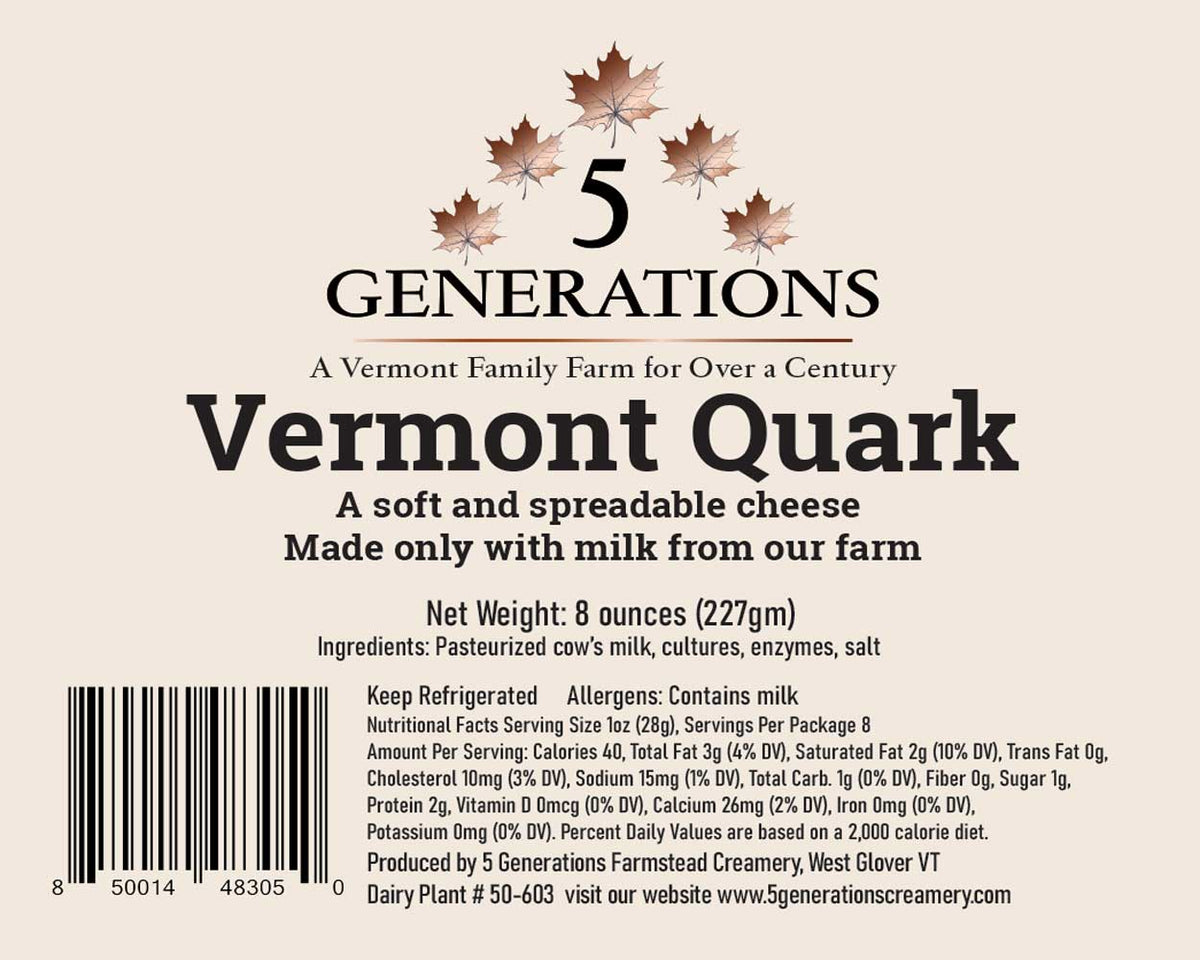
See the quark’s original label and the FAGE 0% cup record for serving-level figures. Our Greek yogurt record uses the 150 g cup label, not an adjacent larger-tub serving.
Check total and added sugar separately. Added sugar is included within total sugar; the two lines should not be added together. The quark’s missing added-sugar value stays unknown. A zero on another product’s added-sugar line does not mean it contains no naturally occurring milk sugar.
Can you substitute one for the other?
For a cold bowl or a dip, you can try the swap and adjust the consistency and seasoning to suit the dish. Start with an unsweetened version if the recipe is savory.
For a cheesecake, baked filling, or another recipe where dairy is a major structural ingredient, use a recipe developed for your chosen product. A spoonable texture does not establish an equal baking substitution, and this guide has not tested a universal conversion ratio.
How to choose at the dairy aisle
- Choose the job: breakfast bowl, spread, dip, or a particular recipe.
- Match the product style: check plain versus flavored and the stated milkfat level.
- Compare the labels: use per 100 g for a common weight, then per serving for your portion.
- Check the evidence: look at the source date and any undeclared values.
Explore the quark collection and Greek yogurt collection, or compare all checked products. The comparison is independent; listing a product is not an endorsement or a stock check.
Sources and review notes
Process descriptions use the references below. Manufacturer sources describe their own products. Nutrition examples use our checked US records or explicitly identified overseas editorial references, with individual source dates, rather than category averages. Overseas references are not US directory listings.
- Canadian Dairy Commission — Quark Cheese
- German Federal Centre for Nutrition — Skyr, Yogurt, and Quark
- Arla Sweden — What is kvarg? (Swedish)
- U.S. Dairy Export Council — Greek-style Yogurt
- 5 Generations Creamery — Fresh Vermont Quark
- FDA — Added Sugars on the Nutrition Facts Label
Editorial references reviewed Oct 29, 2026. Brand formulations and source pages can change; a source check does not verify current packaging or retailer stock.
Put the labels side by side.
Explore checked US products, filter by category, and compare nutrition on the same basis.
Open the comparison